There are only two reasons why alpacas smile a lot: they are happy or their facial anatomy gives us the impression that they are smiling. If they smile when they are happy they are like people which would be unusual. My strong suspicion is that …
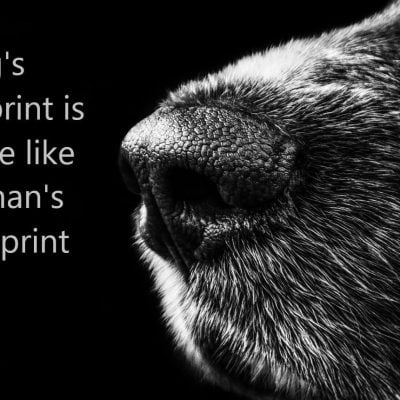
The nose leather (the tip of the nose) of a dog contains a unique “noseprint” like a human’s fingerprint which does no alter over time. This critical fact has allowed a Chinese artificial intelligence start-up company to track lost dogs using their noseprints and it …
Wild animals with bigger brains may be at greater risk of extinction according to a study led by Manuela Gonzales-Suarez of the University of Reading. She said: “We found bigger brains may actually hold mammals back from becoming the most abundant organisms in an area. …
Horses can hear better than humans. They can detect a wider range of sounds in terms of frequency and their hearing is more acute. Whereas horses can hear sounds up to 25,000 Hz (25 kHz), humans can hear sounds up to about 20,000 Hz and …
Yes, a dog’s hearing is better than a human’s at the higher frequencies. At sounds of low pitch or frequency a dog’s ears have about the same ability as those of humans. At the higher end of the frequency range of audible sound, dogs are …
All domestic cats have webbed feet but it is difficult to see the webbing for the obvious reason that their toes are covered in quite dense fur. Incidentally, the domestic cat with the most dense fur on their paws is probably the Maine Coon. This …
The likelihood that humans can detect the Earth’s magnetic field is a discovery of a new human sense. It is called magnetoreception. A study presents the hypothesis that some humans are sensitive to the Earth’s magnetic field. This is relevant to a discussion about our …