
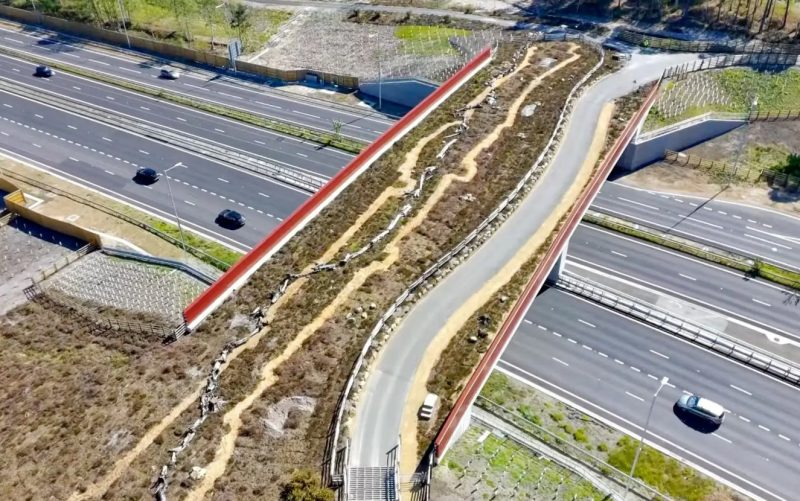
Roads invariably fragment large habitats which makes certain species more vulnerable in terms of survival. The idea therefore behind green bridges is to repair road or railway fragmented habitats with wide, green bridges allowing the wildlife on one side of a road to travel to the other side thus creating a much larger habitat.
One excellent example is the green bridge in Surrey, UK. It is the 68-metre wide Cockcrow Green Bridge which spans the A3, which incidentally is not for from where I live.
The bridge connects two rare heathland habitats and costs £3.7 million to build. It is nice for me to see that the government is at least spending a bit of money on wildlife conservation albeit a fraction of what is spent on, for example, human welfare. This is normal in a very humancentric world.
The Cockcrow Green Bridge provides a safe crossing for wildlife and people betwen Ockham Common and Wisley Common.
These commons support nightjars and Dartford Warblers; both rare birds which rely on the heath to breed.
There are also grass snakes, badgers, bats and toads.
The new bridge replaces a pedestrian bridge built in the 1980s which served humans but not wildlife.
National Highways suggested that it could be the first of many of this type.
Spanning an impressive 30 metres in width, the bridge will reconnect the commons either side of the A3 and provide a natural and safe corridor for local wildlife. It has been designed with reptiles and invertebrates at its heart. – National Highways spokesperson.
You can see that there are also pathways on the bridge and and tracks for cyclists and horses.
